
Fibreglass RoofingFibreglass Flat Roofing A properly laid glass fibre (GRP) roof will last for at least 30 years with no measurable deterioration. The roof must be laid onto a dry deck in dry conditions at a temperature not below 5°C. The resins and top coats should be suitably for use in roofing. This guide relates only to the application of the GRP laminate and top coat. The deck should be of 18 mm exterior plywood or Sterling Board and be well fixed to the underlying joists. Typically two men can strip, re-deck, laminate and top coat a roof of about 20 square metres in one day. Always try to plan starting the roof when a settled period of weather is forecast. The deck may be a new deck, or may be formed over an existing roof. You should ensure that the new deck is laid to adequate falls in order to allow good drainage, so that there is no standing water on the roof after completion.
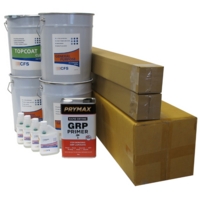
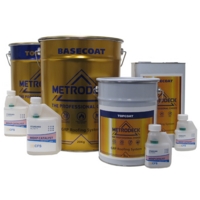
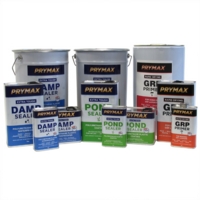
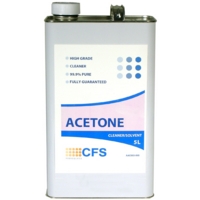
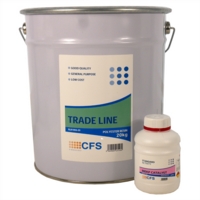
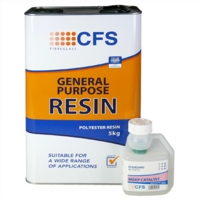
Resin: allow 1.5Kg/m2 for 450g glass or 2 Kg/m2 for 600g glass. Top coat: allow 0.5Kg/m2. Glass: Emulsion bound chopped strand mat (CSM). The minimum should be a single layer of 450gm or for a heavier laminate a single layer of 600gm mat. Acetone, which is the solvent for the resin. Catalyst (hardener) along with a Safety Dispenser. Brushes, Consolidation Rollers and Application Rollers. You will need to form the edge detail with various preformed edge Trims.
1: Trimming: Fitting the edge trims. 2: Bandaging: Reinforcing the board joints. 3: Laminating: Applying the GRP membrane. 4: Top Coating: Applying the final top coat.
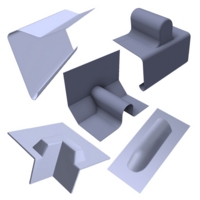
The A200 - Drip facia trim can be offset in order to ensure that the drip stands over the gutter. Preformed corners may be used, or if preferred, mitres can be cut into the trim to form the corner then sealed on site with a patch of glass fibre.
A200 - Drip facia, used wherever the roof drains into a gutter. B230 or B260 - Used along any free standing edge wherever no drainage is required. C100 or C100MT - Used in place of lead wall flashing, usually used with fillet trims. D240, D270 - Fillet trims used wherever a roof meets an abutting wall. E280 - Expansion joint used only on roofs over 100m2. F300 - Flat flashing used mainly as a slate flashing where a pitched roof meets a GRP flat roof.
The procedure for bandaging is the same, on a smaller scale as that used for the main laminate. A small amount of resin, usually about 1 kilo is decanted into a small bucket and mixed with catalyst. (See catalyst addition chart for a guide to the correct amount of catalyst). The resin is the applied to the board edges and to the trim edges with either a 3" brush or small roller. The pre-cut bandage is then rolled out over the resin and a further amount of resin is then applied to the glass bandage, which is allowed to wet out before consolidating with a small consolidation roller. All the detail work may also be completed at this stage, drain outfalls, channels, pipes and roof fittings can all be sealed with GRP You will find that a brush is more useful to form complex shapes and to consolidate the glass than a roller for these details.
Continue with the next "run" of glass overlapping the first by 5Omm. Do not step on the wet glass and resin. Continue this until the roof has been completely covered and the laminate has been well consolidated.
Top Coating: Ensure that the top coat is even and not more than half a mm thick. If the top coat is applied too generously, there is a danger that it will crack. The roof is then complete and will take several days to fully cure. It will not deteriorate and maybe cleaned occasionally with soap and warm water. DO NOT USE BLEACH or any strong alkali on the roof. The roof will withstand foot traffic and may have planters or tiles or other decorative finishes applied to it with no detrimental effects. The edge trims may be painted if required.
*These times may vary according to mix type and catalyst activity used. Catalyst additions: 1) Never use less than 1% even in summer. Just mix less at a time. 2) Never use more than 4% - the cure time will not reduce with more catalyst beyond 4%. 3) Never underestimate the effect of temperature. Resins will not cure at or below freezing and will always cure much faster in direct sunlight. 4) Remarks - when Top Coating late in the day - add more catalyst to allow for the lack of sunlight. 5) You can buy catalysts of different strengths, to partially compensate for winter and summer conditions. 6) Remember any catalysed resin left in the bucket will exotherm. Heat is generated as it cures and it should be left well away from other stored materials. Water may be poured over the resin layer in order to suppress heat gain.
1) Delamination of the laminate from the boards: Moisture in the deck when laminating. 2) Flaking and Cracking of the top coat: Top coating onto a wet laminate or applying the top coat too thickly. 3) Resin cures too fast: Conditions are too hot to lay resin or addition of too much catalyst. 4) Top coat cures too fast: See No.3. 5) Resin cures too slowly or not at all: No catalyst addition or temperature too low. The cure will stop and temperature drops to freezing. 6) Patch or Streaky cure of resin or top coat: Insufficient catalyst and inadequate mixing. 7) Resin does not cure and appears milky white: Water contamination. 8) Excessive fibre pattern: Too little resin and insufficient consolidation.
For Complete Trims Information
Rough Price Guide (Including standard delivery)
| |||||||||||||||||||||||||||||||||||||||||||||||||||